Posts

Showing posts with the label Medicine

Rule of 2 for Tuberculosis

:: Rule of Two for Tuberculosis:: 1.      2 out of 10 word cases of TB are in India 2.      Tuberculosis has 2 words T and B = TB 3.      TB can be pulmonary or extra pulmonary. 4.      Resistant TB can be MDR or XDR Tb. 5.      MDR TB is seen in 2% of new TB cases. 6.      2 patients of every 10 patients are extra pulmonary TB cases 7.      One can treat both sputum positive and sputum negative cases 8.      Sputum negative cases confirm by GeneXpert or LPA test 9.     Don’t ignore fever and cough. 10.   Don’t ignore fever of more than 2 weeks duration. 11.   Don’t ignore cough of more than 2 weeks duration. 12.   Get 2 sputum examination to rule out TB (stat and nearly morning). 13.   Collect 2 ML of sputum for examination. 14.   Sputum can be tested by Z...
ECG Interpretation Checklist

Rate (300/big squares or 1500/ Small Squares) - bradycardia/tachycardia? (n: 60-100/minute) Rhythm - regular/irregular? - sinus rhythm? (regular P preceding QRS) - nodal rhythm? (normal QRS, absent P) - ventricular rhythm? (P follows QRS, QRS length >0.12s/3 small Boxes) - atrial fibrillation? QRS irregularly irregular, No discernible P. - atrial flutter? Sawtooth appearance. Regular QRS Axis (I 0deg; II +60deg; aVF +90deg; III +120deg; aVR -150deg; aVL -30deg) - Mean frontal axis? At 90deg to isoelectric complex. - Left axis deviation? -30deg to -90deg. - Right axis deviation? +90deg to +180deg. P-wave (Positive in I,II,aVF, V4-V6) - Sinoatrial block? Complete/partial - Left atrial hypertrophy? Bifid P. " P mitrale " - Right atrial hypertrophy? Peaked P. " P pulmonale " P-R interval (start of P to start of QRS) - Delayed AV conduction? (>0.2s/5 squares) - Accessory conduction? (<0.12s/3 squares) QRS Complex - Ventricular condu...

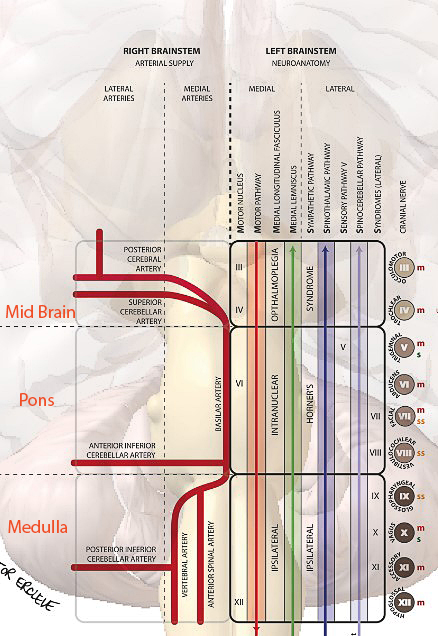
Localisation of Brainstem lesions : Rule of Four

Image
Ugh got destroyed by another brainstem lesion question on Qbank? Having hard time with neurology? then you are at right place.. a simplified method for answering the question ‘Where is the lesion?’   Below I have summarized RULE OF 4.  In the rule of 4 there are 4 rules: There are 4 structures in the ‘midline‘ beginning with M There are 4 structures to the ‘side‘ (lateral) beginning with S There are 4 cranial nerves below the pons, 4 in the pons and 4 above the pons. The 4 motor nuclei that are in the mid line are those that divide equally into 12 except for 1 and 2, that is 3, 4, 6 and 12 (5, 7, 9 and 11 are in the lateral brainstem).   The 4  Medial structures and the associated deficits are: M otor pathway (or corticospinal tract): CL weakness of the arm and leg   M edial Lemniscus: CL loss of vibration and proprioception in the arm and leg   M LF: IPSI inter-nuclear ophthalmoplegia (failure of adduction of the IPSI eye +nystagmus...

Acute pancreatitis complications

Early - GRASS G lucose elevated R enal failure A RDS S epsis S hock Late – NAP N ecrosis of pancreas A bscess P seudocyst

Pancreatitis: treatment

MACHINES : M onitor vital signs A nalgesia/ Antibiotics C alcium gluconate (if deemed necessary) H2 receptor antagonist I V access/ IV fluids N il by mouth E mpty gastric contents S urgery if required/ Senior review

FEATURES OF HYPOGLYCAEMIA

LOW SUGAR EPISODE L = Low BM (< 3.9mmol/l) This value is debatable and varies from one patient to another O = On insulin – Patients on insulin who have missed a meal or breakfast are prone to hypoglycaemia. W = Warmth S = Sweaty skin U = Unconscious G = Generalised seizures A = Aggression R = Rage E = Epileptic fits P = Paresthesia, Pallor I = Irritability S = Shakiness O = Oral Hypoglycaemics D = Death, Delirium E = Emotional patient

Strawberry in Medicine

Strawberry tongue- kawasaki disease,scarlet fever,tss Strawberry gums- wegener's granulomatosis Strawberry hemangioma- capillary hemangioma Strawberry vagina in trichomoniasis. Strawberry skin n nasal mucosa- sarcoidosis Strawberry nasal mass- rhinosporidiosis Strawberry shaped skull - edward syn Strawberry gallbladder -cholesterolosis

Collection of Medical Roses

#Valentine_Day_Special 1. Rose sign - DVT. 2.Rose spot - typhoid. 3.Rose Waller test- rheumatoid factor. 4.Rose pink rash- erysipelas. 5.Rose thron ulcer- Crohn disease. 6.Rose Bengal stain- Sjogren syndrome( eye examination). 7.Rose Bengal card test- brucella. 8.Rose garder's disease- sporothrix scheinki. 9.Rose position- adenoidectomy/ tonsillectomy. 10.Rosewater syndrome-a mild form of hereditary X- linked hypergonadotropic hypogonadism in males, characterized by sterility and gynecomastia. 11.rose fever - hay fever causd by grass polen or rose polen.

Left vs Right Bundle Branch Block

Image
You can distinguish between LBBB (Left Bundle Branch Block) and RBBB (Right Bundle Branch Block) simply by looking at the QRS morphology in V1 and V6.  If the QRS looks like W in V1 and M in V6 it is LBBB. (WiLLiaM)  If the QRS looks like M in V1 and W in V6 it is RBBB. (MoRRoW) You can distinguish between LBBB (Left Bundle Branch Block) and RBBB (Right Bundle Branch Block) simply by looking at the QRS morphology in V1 and V6. If the QRS looks like W in V1 and M in V6 it is LBBB. (WiLLiaM) If the QRS looks like M in V1 and W in V6 it is RBBB. (MoRRoW) - See more at: http://score99.blogspot.in/2009/07/william-morrow-in-bundle-branch-block.html#sthash.DqIR4eY3.dpuf You can distinguish between LBBB (Left Bundle Branch Block) and RBBB (Right Bundle Branch Block) simply by looking at the QRS morphology in V1 and V6. If the QRS looks like W in V1 and M in V6 it is LBBB. (WiLLiaM) If the QRS looks like M in V1 and W in V6 it is RBBB. (MoRRoW) - See m...