Posts

Showing posts with the label USMLE

Differential Diagnosis of Chronic Watery Diarrhea

Chronic Watery Diarrhea can be subdivided in: osmotic, secretory and functional. Secretory Diarrhea:: bowel secretes too much fluid  VERY HIGH volume stools (>1L) Stool Osmolar Gap less than 50. No changes on Fasting. Caused by enterotoxins, bile acids(when ileal resection), carcinoid sx, VIPoma. Osmotic Diarrhea::   Non absorbable solutes that stay in bowel and drag water in its SMALLER volume stools. (<1L) Stool Osmolar Gap more than 50. Stops on fasting. ex. lactose intolerance and celiac disease Functional Diarrhea::   IBS, where hallmark is hypermotility,  has smaller volume and symptoms disappear at night.
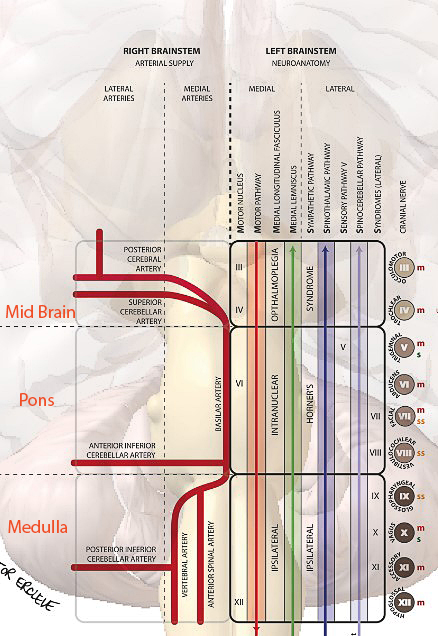
Localisation of Brainstem lesions : Rule of Four

Image
Ugh got destroyed by another brainstem lesion question on Qbank? Having hard time with neurology? then you are at right place.. a simplified method for answering the question ‘Where is the lesion?’   Below I have summarized RULE OF 4.  In the rule of 4 there are 4 rules: There are 4 structures in the ‘midline‘ beginning with M There are 4 structures to the ‘side‘ (lateral) beginning with S There are 4 cranial nerves below the pons, 4 in the pons and 4 above the pons. The 4 motor nuclei that are in the mid line are those that divide equally into 12 except for 1 and 2, that is 3, 4, 6 and 12 (5, 7, 9 and 11 are in the lateral brainstem).   The 4  Medial structures and the associated deficits are: M otor pathway (or corticospinal tract): CL weakness of the arm and leg   M edial Lemniscus: CL loss of vibration and proprioception in the arm and leg   M LF: IPSI inter-nuclear ophthalmoplegia (failure of adduction of the IPSI eye +nystagmus...

What is USMLE step-1? Know A to Z

WHAT IS STEP 1?? USMLE Step 1 is an exam in which the knowledge of basic sciences is tested. Every medical student (US graduates as well as international graduates like us) are required to give this exam if they plan on working as a physician/surgeon in USA. The subjects included in step 1 are:  Physiology  Biochemistry & Genetics  Anatomy  Pathology ( bulk of exam questions )  Microbiology and Immunology  Pharmacology  Behavior Sciences & Bio statistics. The exam itself is one of the toughest exams in the life of a medical student (not because of the exam content, but because of the number of subjects being tested in a single exam). Step 1 is a broadly based, integrated examination. Test items commonly require you to perform one or more of the following tasks:  Interpret graphic and tabular material (This is heavily tested these days)  Identify gross and microscopic pathologic and normal specimens  Apply basic ...