Posts

Showing posts with the label short note

PCPNDT Act 2003

Preconception and prenatal Diagnostic Techniques Act 2003 (PCPNDT) prohibits sex selection before or after conception and the use of pre-natal diagnostic techniques to determine sex of fetus.It  is an  Act  of the  Parliament of India  enacted to stop female  foeticides  and arrest the declining sex ratio in India. Sex can be Determined By: 1. Amniocentesis 2. Chorionic villous biopsy 3. Ultrasonography scan and imaging techniques Objective:   The main purpose of enacting the act is to ban the use of sex selection techniques after conception and prevent the misuse of prenatal diagnostic technique for sex selective  abortion. Features of PCPNDT Act: Act prohibits sex selection before or after conception Regulates the use of prenatal diagnostic techniques Gynecologist or RMP have to conduct pre-natal diagnostic techniques at recognized place only. Nursing home or RMP or hospital where ultrasonography is used hav...
Microlaryngoscopy

Microlaryngoscopy is a procedure in which the larynx is visualized through a microscope. It thus allows a magnified view of the larynx which is not possible on direct or indirect laryngoscopy. History: Kleinsasser in 1960 introduced and popularised the new microlaryngoscope used in conjunction with the microscope. Indications: Diagnostic: To have a microscopic visualization of the larynx in cases of hoarseness of voice which cannot be diagnosed by indirect or direct laryngoscopy . Biopsy of laryngeal lesions. Also, the extent of the growth can be seen by this procedure. For assessment of laryngeal trauma. Therapeutic: Removal of foreign bodies Injection of teflon paste in the vocal cords in cases of vocal cord palsy Laser cordectomy in carcinoma of vocal cord Dilatation of subglottic stenosis Insertion of laryngeal stent Arytenoidectomy in cases of abductor cord palsy Excision of vocal nodules, cysts and haemangiomas Technique: Patient is under general...

Autopsy Writing Made Easy!

           Autopsy writing is compulsory question in university exam. It is relatively easy if you have read pathology properly but it is time consuming. we have to recollect all characteristic points of different condition and write in specific format. Here are the characteristic points for frequently asked conditions so revising it become easy and time saving. I hope this helps!!! Basic Common Theme:   Name, age, sex, admitted on, died on   Brief clinical history   Summary of lab investigation   Clinical diagnosis   Autopsy findings   External appearance   Weight of organs Normal weight           •    Lungs 450gm(left) 550gm (right)           •    Spleen 150-200gm           •    Liver 1200gm           •  ...

Crystals in Urine: Alkaline Urine

Image
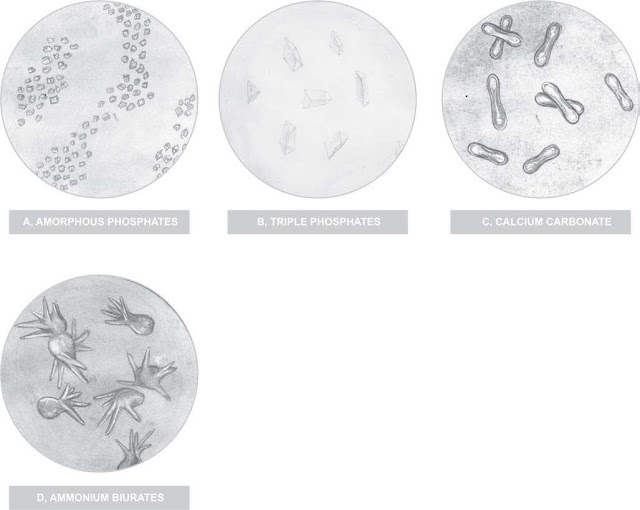
Crystals in Alkaline Urine These are as under : i. Amorphous phosphate ii. Triple phosphate iii. Calcium carbonate iv. Ammonium biurate i) Amorphous Phosphate They are seen as colourless granules in the form of clumps or irregular aggregates .They dissolve when urine is made acidic. ii) Triple Phosphate They are in the form of prisms and sometimes in fern leaf pattern .They dissolve when urine is made acidic. iii) Calcium Carbonate They are in the form of granules, spheres or rarely dumbbell-shaped. They again dissolve in acidic urine. iv) Ammonium Biurate They are round or oval yellowish-brown spheres with thorns on their surface giving ‘thorn apple’ appearance . They dissolve on heating the urine or by making it acidic.

Crystals in Urine: Acidic Urine

Image
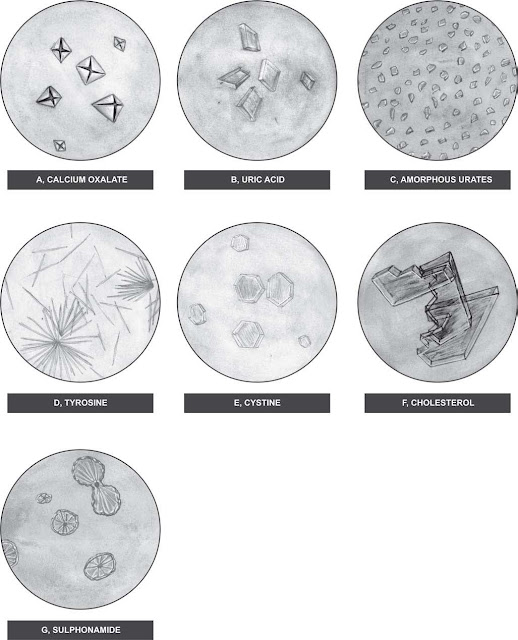
Crystals Formation and appearance of crystals in urine depends upon pH of the urine, i.e. acidic or alkaline. Crystals in Acidic Urine  These are as under : i. Calcium oxalate ii. Uric acid iii. Amorphous urate iv. Tyrosine v. Cystine vi. Cholesterol crystals vii. Sulphonamide i) Calcium Oxalate These are colourless refractile and have octahedral envelope-like structure. They can also be dumb-bell shaped ii) Uric Acid They are yellow or brown rhomboid-shaped seen singly or in rosettes. They can also be in the form of prism, plates and sheaves iii ) Amorphous Urate They appear as yellowish brown granules in the form of clumps. They dissolve on heating. When they are made of sodium urate, they are needle-like in the form of thorn-apple. They are passed more often in patients having gout. iv ) Tyrosine They are yellowish in the form of silky needles or sheaves .They are passed in urine in jaundice. v) ...